Implicit vs Complicit: Meaning, Differences & Examples

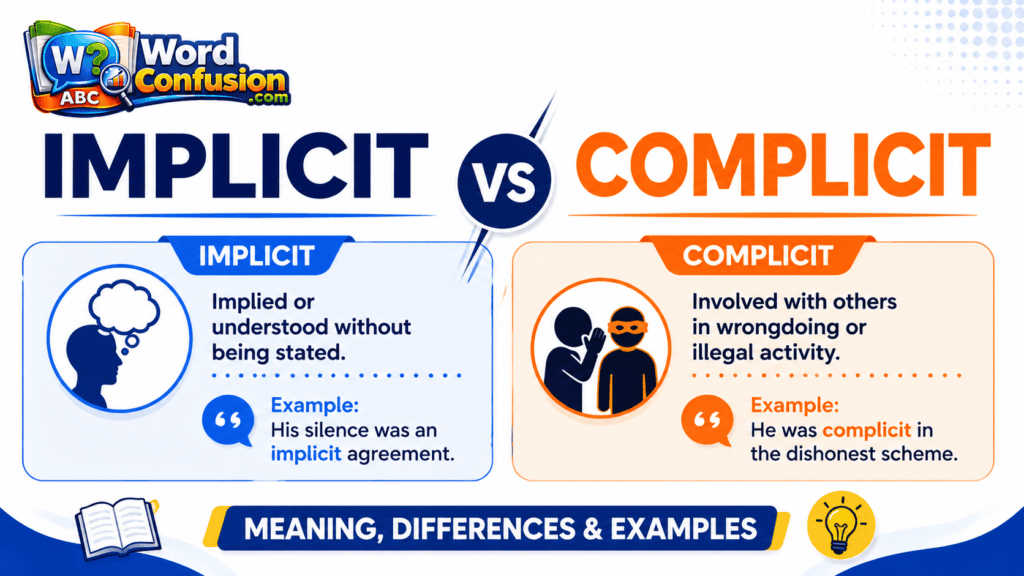
Implicit and complicit look and sound somewhat similar, but they have completely different meanings. Implicit describes something that is suggested, understood, or present without being directly stated. Complicit describes someone who is involved in or helps with wrongdoing.
In simple terms:
Implicit = implied or unstated
Complicit = involved in wrongdoing
For example, an implicit message is not expressed directly, while a person who knowingly helps with a crime may be complicit in it.
📖 See also:Notable vs Noteable: Which Spelling Is Correct?
Implicit vs Complicit: Quick Answer
The main difference between implicit and complicit is what they describe.
Implicit refers to something that is suggested or understood without being directly expressed. Complicit refers to involvement in wrongdoing, especially when someone knowingly participates in, assists, or supports it.
| Word | Meaning | Main Idea | Example |
| Implicit | Suggested but not directly stated | Implied meaning | Her criticism was implicit. |
| Complicit | Involved in wrongdoing | Participation or responsibility | He was complicit in the fraud. |
These words are not interchangeable.
What Does Implicit Mean?
Implicit means something is suggested, understood, or contained without being stated openly or directly.
It is often used for meanings, messages, assumptions, attitudes, agreements, or expectations.
Implicit Definition
Implicit means:
Suggested or understood without being directly expressed.
If someone communicates an idea without saying it clearly, that idea may be described as implicit.
For example:
- Her answer contained an implicit criticism.
- There was an implicit agreement between the two companies.
- His comments carried an implicit warning.
- The teacher’s question had an implicit assumption.
In each case, the meaning is present but not stated directly.
Simple Meaning of Implicit
Think of implicit as implied.
If something is implicit, you may need to understand the context to recognize what is being communicated.
For example:
Sarah looked at the clock several times during the meeting.
She never said she wanted to leave, but her actions may contain an implicit message that she was ready to go.
Examples of Implicit
Everyday example:
His silence was an implicit sign that he disagreed.
Workplace example:
The manager’s comments contained an implicit expectation that everyone would arrive on time.
Academic example:
The study makes an implicit assumption about consumer behavior.
Conversation example:
When Maya said, “Some people should check their work more carefully,” the criticism of her colleague was implicit.
What Does Complicit Mean?
Complicit means involved in wrongdoing or helping someone carry out something wrong or harmful.
It is generally used when a person or organization has some form of involvement or responsibility in improper activity.
Complicit Definition
Complicit means:
Involved in or knowingly helping with wrongdoing.
For example:
The employee was complicit in the fraud.
This means the employee was involved in the fraudulent activity rather than merely knowing that it happened.
Simple Meaning of Complicit
A useful way to remember complicit is:
Complicit = involved in wrongdoing
It is related to complicity, which means involvement in wrongdoing.
For example:
- The manager was complicit in the cover-up.
- Several people were accused of being complicit in the scheme.
- Anyone who knowingly helps the operation may be considered complicit.
The exact legal meaning of complicity can depend on the jurisdiction and circumstances, so complicit should not automatically be treated as a legal finding simply because someone knew about an event.
Examples of Complicit
Workplace example:
The employee was complicit in hiding the financial records.
Ethical example:
By knowingly helping the company mislead customers, he became complicit in the deception.
Crime-related example:
Investigators believed that the driver was complicit in the robbery.
Everyday example:
If you knowingly help someone cheat, you may be described as complicit in the cheating.
What Is the Difference Between Implicit and Complicit?
The easiest way to understand the difference is to focus on what each word describes.
Implicit describes meaning
Something is implicit when it is suggested rather than directly stated.
Her message was implicit.
This means the message was not expressed openly, but its meaning could be understood.
Complicit describes involvement
Someone is complicit when they are involved in wrongdoing.
He was complicit in the crime.
This means he had some involvement in the wrongdoing.
The simplest distinction
Implicit = what is implied
Complicit = who is involved
This is the key difference to remember.
Implicit vs Complicit Examples
Seeing the words in different contexts makes the distinction clearer.
Example 1: Communication
The teacher’s warning was implicit.
The teacher did not directly say what would happen, but the warning could be understood.
You would not normally say:
The teacher’s warning was complicit.
That would not express the intended meaning.
Example 2: Wrongdoing
The manager was complicit in the fraud.
The manager was involved in the wrongdoing.
You would not replace complicit with implicit:
The manager was implicit in the fraud.
That does not normally communicate the intended idea.
Example 3: Workplace
There was an implicit expectation that employees would respond quickly.
The expectation was understood without being directly stated.
Compare:
The employee was complicit in falsifying the report.
Here, complicit describes involvement in wrongdoing.
Example 4: Conversation
Her refusal to answer was an implicit indication that she disagreed.
The meaning was indirect.
Compare:
Her colleague was complicit in the deception.
The colleague was involved in wrongdoing.
📖 See also:What Does EYP Mean in Text? Meaning, Slang & Examples
How to Use Implicit in a Sentence
Use implicit when you are talking about something that is suggested, understood, or not directly expressed.
Examples:
- His answer contained an implicit criticism.
- There was an implicit agreement between the two parties.
- The advertisement made an implicit promise about the product.
- Her expression gave an implicit indication that she was unhappy.
- The article contains an implicit assumption about human behavior.
- The rules create an implicit expectation of fairness.
- His comments carried an implicit warning.
A common pattern is:
implicit + noun
Examples include:
- implicit assumption
- implicit meaning
- implicit message
- implicit agreement
- implicit bias
- implicit expectation
- implicit criticism
- implicit understanding
How to Use Complicit in a Sentence
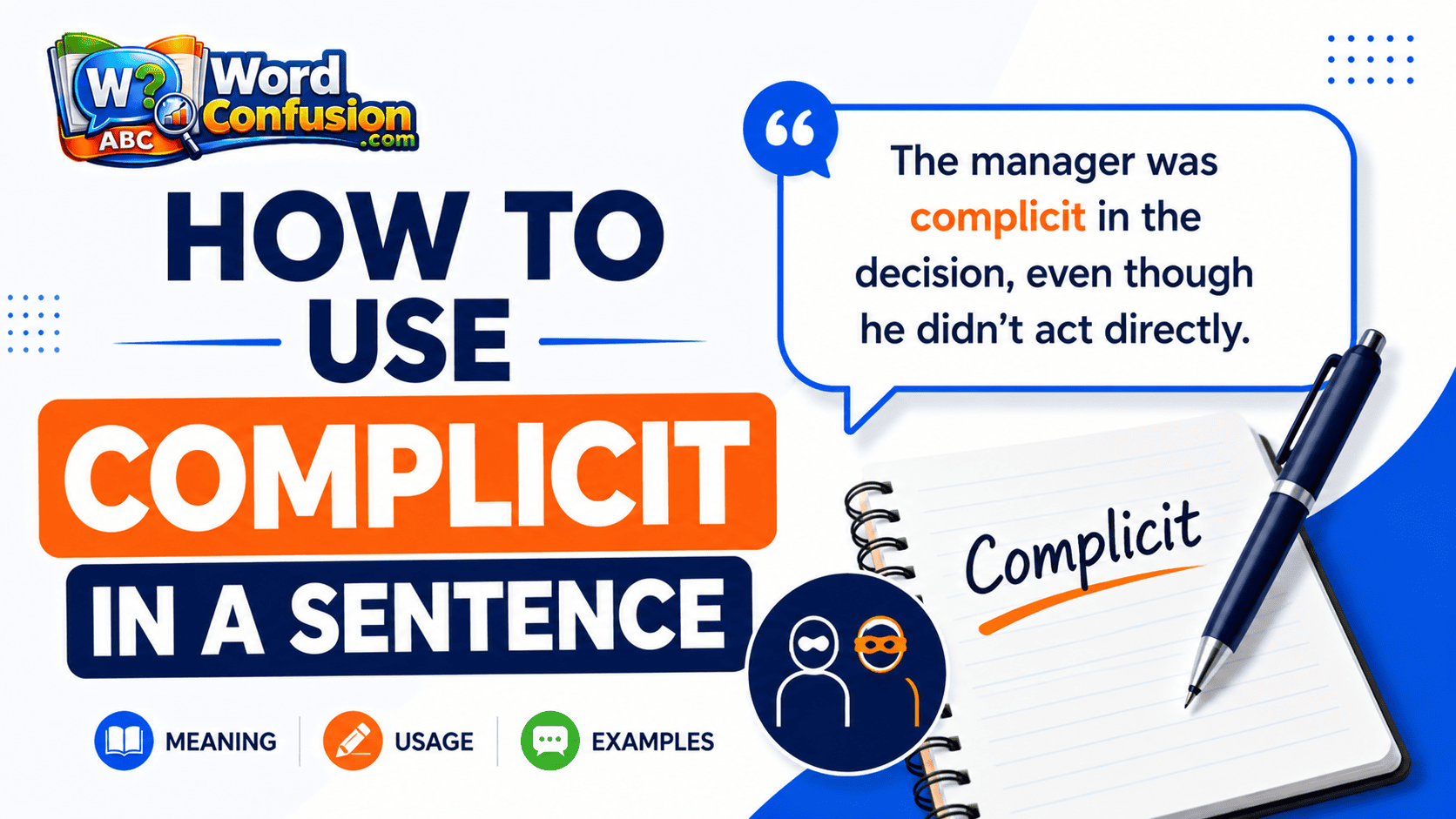
Use complicit when describing involvement in wrongdoing or improper behavior.
It is commonly followed by in.
Examples:
- He was complicit in the scheme.
- The manager was complicit in the cover-up.
- Several officials were accused of being complicit in the corruption.
- She refused to become complicit in the deception.
- The investigation examined whether the company was complicit in the misconduct.
- Anyone who knowingly assists the operation could be considered complicit.
A common structure is:
be + complicit + in + wrongdoing
For example:
She was complicit in the fraud.
Implicit vs Explicit vs Complicit
Implicit, explicit, and complicit can sometimes appear in the same vocabulary discussion, but they have different meanings.
| Word | Meaning | Example |
| Implicit | Suggested but not directly stated | His criticism was implicit. |
| Explicit | Directly stated or clearly expressed | His criticism was explicit. |
| Complicit | Involved in wrongdoing | He was complicit in the deception. |
The relationship between the first two is especially important:
Implicit ↔ Explicit
These words are often opposites in terms of communication.
Complicit is different because it concerns involvement in wrongdoing, not whether something is directly or indirectly communicated.
Example
- The warning was implicit.
- The warning was suggested rather than directly stated.
- The warning was explicit.
- The warning was stated clearly.
- The employee was complicit in the wrongdoing.
- The employee was involved in the wrongdoing.
Why Are Implicit and Complicit Confused?
These words are commonly confused because they have similar-looking structures and sounds.
Both:
- begin with im-
- contain several similar letters
- have a similar rhythm
- frequently appear in formal or academic writing
However, their meanings are unrelated enough that they should not be used interchangeably.
A good memory rule is:
Implicit → implied
Complicit → involvement
Common Mistakes With Implicit and Complicit
Mistake 1: Using complicit for an unstated meaning
Incorrect:
The author’s message was complicit.
If you mean that the message was suggested rather than directly stated, implicit is the appropriate word.
Correct:
The author’s message was implicit.
Mistake 2: Using implicit for involvement in wrongdoing
Incorrect:
He was implicit in the fraud.
If you mean that he knowingly participated in or helped with the wrongdoing, complicit is normally the correct choice.
Correct:
He was complicit in the fraud.
Mistake 3: Assuming complicit means simply “aware”
Being aware of wrongdoing and being complicit are not necessarily the same thing.
Complicit generally suggests some form of involvement, assistance, participation, or contribution. The precise circumstances matter.
Mistake 4: Assuming silence always makes someone complicit
Silence alone does not automatically make someone complicit.
Whether silence amounts to involvement depends on the circumstances, such as what the person knew, what role they had, and whether they intentionally assisted or supported the wrongdoing.
Is Implicit the Same as Complicit?
No. Implicit and complicit are not the same.
Implicit means something is suggested or understood without being directly stated.
Complicit means someone is involved in wrongdoing.
For example:
The message was implicit.
The employee was complicit in the fraud.
The first sentence concerns communication. The second concerns involvement.
Easy Memory Trick for Implicit and Complicit
Use these two shortcuts:
Implicit = Implied
Both words relate to something that is suggested rather than directly stated.
Complicit = Involved
Think of complicit as being connected to an improper action or wrongdoing.
So remember:
Implicit = implied
Complicit = involved
If you remember those two phrases, you can usually choose the correct word.
📖 See also:Uninclined vs. Disinclined: Differences, Usage, and Examples
Pronunciation of Implicit and Complicit
The words are pronounced differently enough to distinguish them when spoken carefully.
Implicit: im-PLIS-it
Complicit: kuhm-PLIS-it
They share the stressed -plis-it sound, which may contribute to confusion, but their meanings are completely different.
Implicit vs Complicit for Students
For students, the easiest distinction is:
Implicit is about a meaning that is not directly stated.
Complicit is about involvement in wrongdoing.
In English class
The author’s implicit meaning was difficult to identify.
This means the author did not state the meaning directly.
In law or ethics
The assistant was accused of being complicit in the scheme.
This means the assistant was allegedly involved in the wrongdoing.
Remember that legal conclusions about complicity depend on the relevant facts and law.
Frequently Asked Questions
What is the difference between implicit and complicit?
Implicit means suggested or understood without being directly stated. Complicit means involved in or knowingly helping with wrongdoing.
Example:
Her criticism was implicit, but he was complicit in the deception.
What does implicit mean?
Implicit means suggested, understood, or contained without being directly expressed.
Example:
There was an implicit agreement between them.
The agreement was understood even though it was not clearly stated.
What does complicit mean?
Complicit means involved in wrongdoing or helping with an improper action.
Example:
The employee was complicit in the cover-up.
Is implicit the same as complicit?
No. Implicit relates to something implied or unstated, while complicit relates to involvement in wrongdoing.
Can implicit and complicit be used interchangeably?
No. They have different meanings and grammatical uses.
Use implicit for implied or unstated meanings, assumptions, messages, or expectations.
Use complicit for involvement in wrongdoing.
What is an example of implicit?
His response contained an implicit warning.
The warning was understood without being directly stated.
What is an example of complicit?
The manager was complicit in the fraud.
The manager was involved in the wrongdoing.
How do you use implicit in a sentence?
You can use implicit before a noun to describe something suggested rather than directly stated.
The article contains an implicit assumption.
How do you use complicit in a sentence?
Complicit is commonly used with in when describing involvement in wrongdoing.
She was complicit in the deception.
What is the difference between implicit and explicit?
Implicit means suggested or not directly stated, while explicit means directly stated or clearly expressed.
Implicit: The criticism was suggested.
Explicit: The criticism was stated directly.
Is complicit the same as complacent?
No.
Complicit means involved in wrongdoing.
Complacent means overly satisfied or unconcerned, often because someone does not recognize a problem or risk.
For example:
He was complicit in the fraud.
versus:
He became complacent about the security risks.
These are separate vocabulary distinctions.
Key Takeaway
The difference between implicit and complicit is simple once you focus on what each word describes.
Implicit = implied, unstated, or understood indirectly.
Complicit = involved in or helping with wrongdoing.
Use implicit for messages, meanings, assumptions, expectations, and ideas that are not directly expressed. Use complicit when describing a person or organization involved in improper or harmful activity.
Implicit is about what is implied. Complicit is about involvement.
Looking for more English word meanings, grammar tips, and commonly confused words? Visit the WordConfusion homepage to explore our latest language guides, spelling differences, vocabulary explanations, text abbreviations, and practical examples. Whether you’re learning English or improving your writing skills, you’ll find clear, easy-to-understand resources for everyday communication.
Written by
 Abdul Moeed
Abdul Moeed is a professional content writer and SEO link-building specialist with 5+ years of experience. He creates search-optimized content and develops effective SEO strategies that improve website visibility, authority, and organic growth.
View LinkedIn profileLatest posts
 What Does PG Mean in Text? Meaning, Examples & Usage
 What Does OFCC Mean in Text? Meaning, Uses & Examples
 What Does MSG Mean in Text? Meaning, Examples & Usage
 What Does STY Mean in Text? Meaning, Examples & Usage
 What Does “Twin” Mean in Slang? Meaning, Text & Examples
 What Does LMC Mean in Text? Meaning, Examples & Usage